
Douglas County Most Wanted Listings
The sheriff maintains a focused public-safety page at the Douglas County Most Wanted index, and it stands apart from the county's broader warrant search. Some entries carry photos and descriptions. Others get pulled when a case is resolved. There is no published update schedule, so the official page is the only reliable view of what is currently listed. A 2025 redesign announcement from the agency describes the wanted material in those terms.
A wanted notice is a request for public help. It can be withdrawn, and listings have been recalled before. Errors happen too. The sheriff asks that mistakes be reported straight to the agency rather than debated elsewhere. Someone on the wanted list may already be in custody; for that answer, the county's official booking and roster lookup is the right tool, since a wanted entry says nothing about an arrest.
The county keeps these records separate for good reason. The wanted index routes safety tips. The warrant page covers court process. Neither one doubles as a recent-arrest list. A person can sit in jail on a booking with no warrant, or have a warrant on file with no jail entry at all. Match your question to the right source, and the two records stop blurring together.
Douglas County Wanted Listing Fields
The public interface lets you search and sort the sheriff's wanted material, though no fixed field layout covers every profile. A missing photo, a recalled tag, or a changed entry should never be filled in with guesswork. Read the label beside the listing itself. When accuracy matters, note when you accessed it. Any identity match is worth confirming with the sheriff or the court before you act on it.
| Official listing element | How to read it |
|---|---|
| Name search | Use the agency's spelling controls to narrow the list. Similar names are not identity confirmation. |
| Current or arrested status | These interface choices describe the list view, not a final court disposition. |
| Sort controls | Newest-to-oldest and oldest-to-newest settings help arrange displayed entries; they do not certify an update time. |
| Description or image | View any currently published material only on the sheriff's page. The presentation can vary by entry. |
| Recall or error notice | Use it as a signal to verify with law enforcement, not as proof that every other record is current. |
The sheriff's Most Wanted disclaimer states the reliability limit plainly and asks that errors go directly to the agency.
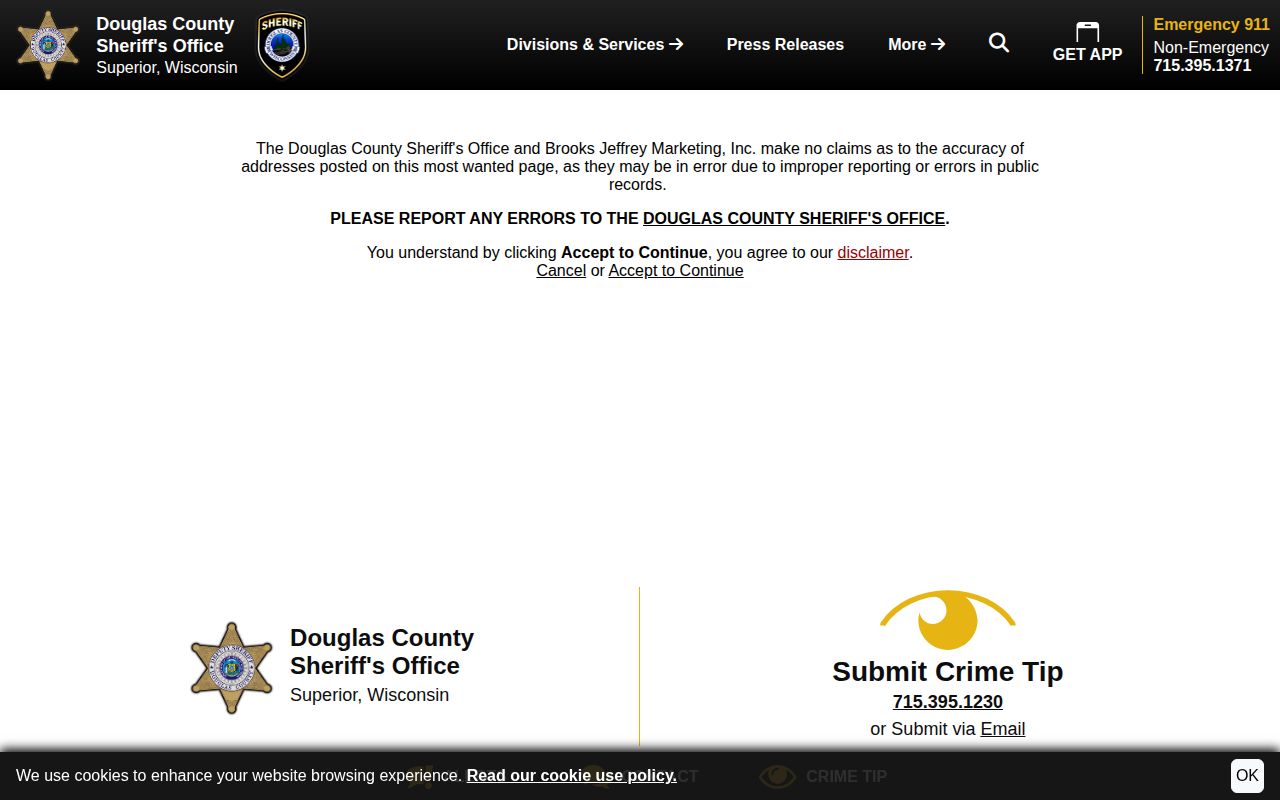
That disclaimer is an official-source capture, not a gallery of wanted persons. A name or status belongs with the responsible office. Readers should verify before relying on anything shown there.
Note: The official disclaimer says its information may be inaccurate, so treat a public wanted record as unverified rather than certified court data.
Photos and descriptions, when shown, stay attached to the agency's own listing. A blank photo is not a reason to identify someone by name alone. And a displayed photo is just part of an agency notice. It does not fix a person's current location. A tip to the sheriff should describe what you actually saw, not an identification built from a public image.
Use Douglas County Wanted Information Safely
The wanted list exists to move information to law enforcement. It is not a license to investigate someone, spread a claim as fact, or make contact. Recognize a name? Pass along limited, firsthand details through the sheriff's reporting channels. Immediate danger changes the math. Call emergency services first. Otherwise a quiet tip does the job without dragging you into a confrontation.
- Open the official Most Wanted index and read the listing and its disclaimer as they appear on that date.
- Compare only firsthand information, such as a known location or vehicle detail, and avoid trying to verify a person in the field.
- For an emergency or imminent danger, call 911. Do not follow, confront, or attempt to detain anyone.
- For non-emergency information, use the sheriff's crime-tip channel or the published tip telephone number.
A social-media repost, an old screenshot, or a secondary index is a poor way to judge whether a listing is still active. Those copies linger after the official page changes. The sheriff's own disclaimer flags the chance of inaccurate information. It also points errors back to the agency. A short safety report, kept to the facts, gives the sheriff something to check against current records.
Check Douglas County Warrant Records
Want to dig past the Most Wanted list? The county's real workhorse is the Douglas County warrant search. It works best when you search by name or date, not for recent bookings. You can enter a first or last name, pick sorting options, and browse result cards that list things like age, warrant date, bond, and charges. Don't count on the displayed total staying fixed. That number shifts constantly, so treat it as a rough signal rather than a crime statistic.
What if the name matches yours exactly? Take a breath before assuming anything. A listing can lag behind a payment, a recall, or some other court action that resolved the matter weeks ago. No separate warrant-verification phone line is published, so call the sheriff's main number or the court clerk to confirm what you're seeing. Anyone who might be personally affected should let an attorney or the court sort out the next step.
| Warrant-search field | Purpose in the official tool |
|---|---|
| Name | Starts a first- or last-name lookup. |
| Date | Changes the way listed warrant entries can be viewed or sorted. |
| First and last name | Helps narrow an identity, but does not replace agency confirmation. |
| Sort order | Arranges shown results and is not a statement of warrant validity. |
- Search the official warrant page using the person's correct name, then read the displayed date and charge information carefully.
- Do not assume that a matching name establishes identity or that the result is still executable.
- Contact the Douglas County Sheriff's Office at 715-395-1371 or the Clerk of Courts at 715-395-1203 to confirm the proper next contact.
- If the question concerns the named person, contact an attorney or the court to address it safely and lawfully.
A public warrant card is a starting point, nothing more. It can't confirm the reach of a court order or offer legal guidance. Unsure whether a listing applies to you? Pick up the phone. Ask the agency or the clerk's office which court to contact. That one call beats guessing, especially with a common name, an old listing, or a situation that seems to have moved on since the entry first appeared.
Douglas County Warrant Labels
Warrant listings come loaded with shorthand. Douglas County's sheriff FAQ defines the abbreviations you'll run into, which helps explain why a call to the court sometimes matters more than decoding a label on your own. Keep the labels in perspective, though. The county doesn't slot every entry into one universal category, so the actual record and the court always control. Read a label as a prompt for the right question to ask, not as a verdict hiding in an abbreviation.
| Label | Sheriff FAQ meaning |
|---|---|
| UF | Unpaid fines. |
| FTA | Failure to appear. |
| Body Only | The person must appear in court. |
Those definitions come straight from the official sheriff FAQ. For confirmation at the courthouse, the Douglas County Clerk of Courts answers at 715-395-1203 and can route you to criminal or traffic contacts. Keep your records straight, too. A booking, a warrant, and a final disposition are three different things, and each lives in its own record.
Douglas County Wanted Tips
Got something to report? The sheriff offers a crime-tip form for non-emergency information. A few ground rules apply. Nobody monitors the form around the clock, so emergencies belong at 911. The agency also cautions that email isn't a secure channel, which means sensitive details should go by phone instead. Under the sheriff's Crime Stoppers policy, designated anonymous tips may qualify for a cash reward, and the Criminal Investigations Bureau coordinates what comes in. Eligibility, though, is never a guarantee of payment.
Non-emergency crime-tip phone: 715-395-1230
Emergency or immediate danger: 911
Official route: Douglas County Sheriff crime-tip form
Anonymous-tip and reward policy: Douglas County Crime Stoppers policy
Stick to what you saw with your own eyes when you call in a tip. Resist the urge to post someone's whereabouts or name them online. Trained staff on the other end of the report know how to weigh a lead properly, and that protects the whole process from turning into rumor.
The sheriff's online form takes uploads, too.
Photos, video, audio, and other files up to 20 MB are all accepted. Just know that email and web forms are not secure channels. Anything sensitive belongs in a phone call instead. Think of the form as one reporting route, not a public comment board.
Douglas County Wanted Alerts and Court Follow-Up
Want updates without checking the site daily? The Douglas County Sheriff app page describes a mobile app offering public information on inmates, warrants, and most wanted material. There's also an email-alert signup with categories covering Most Wanted and other public-safety items. Neither promises a notice for every warrant, a personal photo alert, or anything in real time. Treat both as convenience channels. Then go back to the official record when status truly matters.
After an arrest or charge, the court file tells the rest of the story. Search Wisconsin Circuit Court Access and narrow by name, county, and case type. Court entries can show charging decisions, hearings, dismissals, pleas, or sentences. They won't always include every underlying report or a booking image. That split matters. Warrant entries and public notices start a legal story, but the court disposition is where its ending gets written.
The alert categories simply flag new public material as it's published. They don't guarantee that an individual record appears, appears quickly, or comes with a photograph. The app plays the same role as a public-information access point. For urgent safety concerns, call 911. For non-emergency warrant or case questions, return to the sheriff's office, the clerk, an attorney, or the court.
Note: The app and alerts offer publication access, while later case events live in the court record.